Configurações
 Entrega rápida
 Incoterms
 Tipos de pagamentos


 Produto do Mercado


Automotive Ethernet: The Backbone of Modern In-Vehicle Communication
The modern automobile has evolved far beyond being a simple mode of transport, it is now an intelligent, connected, and software-driven platform. As vehicles become increasingly autonomous and data-centric, the need for a high-speed, scalable, and reliable in-vehicle communication backbone is greater than ever. At the forefront of this evolution is Automotive Ethernet, the cornerstone technology enabling seamless, real-time communication across advanced vehicle subsystems.
From infotainment and ADAS (Advanced Driver-Assistance Systems) to V2X connectivity and over-the-air (OTA) updates, Single Pair Ethernet (SPE) has rapidly become the preferred communication standard for next-generation vehicles (Figure 1). Offering lightweight cabling, superior bandwidth, and cost efficiency, Automotive Ethernet is redefining how data flows across vehicles making them smarter, faster, and more connected than ever before.
 Figure 1: The technical advantages of automotive single-pair Ethernet. (Image source: iWave Global)
Understanding Automotive Ethernet
Automotive Ethernet (based on 100BASE-T1 and 1000BASE-T1 standards) adapts conventional Ethernet for in-vehicle communication by transmitting and receiving data over a single pair of unshielded twisted wires.
Unlike traditional Ethernet (10BASE-T or 100BASE-TX) that requires multiple wire pairs, Automotive Ethernet achieves full-duplex communication on a single twisted pair, reducing wiring complexity, weight, and cost.
At the heart of this innovation is OABR (Open Alliance BroadR-Reach) a physical layer standard derived from 100BASE-T1, which allows multiple electronic control units (ECUs) to communicate simultaneously over the same lightweight cabling. The result is a 30% reduction in cabling weight and up to 80% lower installation costs, enhancing both efficiency and vehicle performance.
- 100BASE-T1 (100 Mbps) uses 4B3B and PAM3 modulation to minimize EMI and enable full-duplex operation.
- 1000BASE-T1 (1 Gbps) employs PAM8 modulation with echo cancellation and equalization, ensuring reliable data transmission across automotive-grade links.
Both standards rely on robust PHY layer encoding and decoding, ensuring signal integrity and low latency essential for data-driven automotive systems.
Precision Synchronization: Master–Slave Architecture
Automotive Ethernet communication follows a Master–Slave model to ensure precise synchronization, which is vital for real-time in-vehicle operations. The master node (typically the domain controller or gateway) generates the clock signal, while slave nodes (sensors, cameras, ECUs) align using gPTP (Generalized Precision Time Protocol).
This clock synchronization minimizes latency and jitter, ensuring accurate, deterministic communication a critical factor in systems like ADAS, autonomous control, and real-time diagnostics (Figure 2).
 Figure 2: Automotive Ethernet is a key component in many systems. (Image source: iWave Global)
Why Automotive Ethernet Matters in Telematics Devices
Telematics Gateways serve as the communication nerve center of connected vehicles aggregating data from ECUs, managing cloud connectivity, and enabling real-time updates. As data volumes and bandwidth requirements rise, traditional automotive protocols such as CAN, LIN, or FlexRay are no longer sufficient.
Automotive Ethernet delivers the high bandwidth, low latency, and scalability that modern telematics applications demand. It enables faster data exchange for V2X communication, GPS tracking, OTA updates, and cloud analytics, while ensuring robust security through encryption, secure boot, and Time-Sensitive Networking (TSN).
In short, Automotive Ethernet provides the foundation for intelligent, connected, and secure mobility making it indispensable in next-generation telematics design.
iWave’s Telematics Solutions with Automotive Ethernet Support
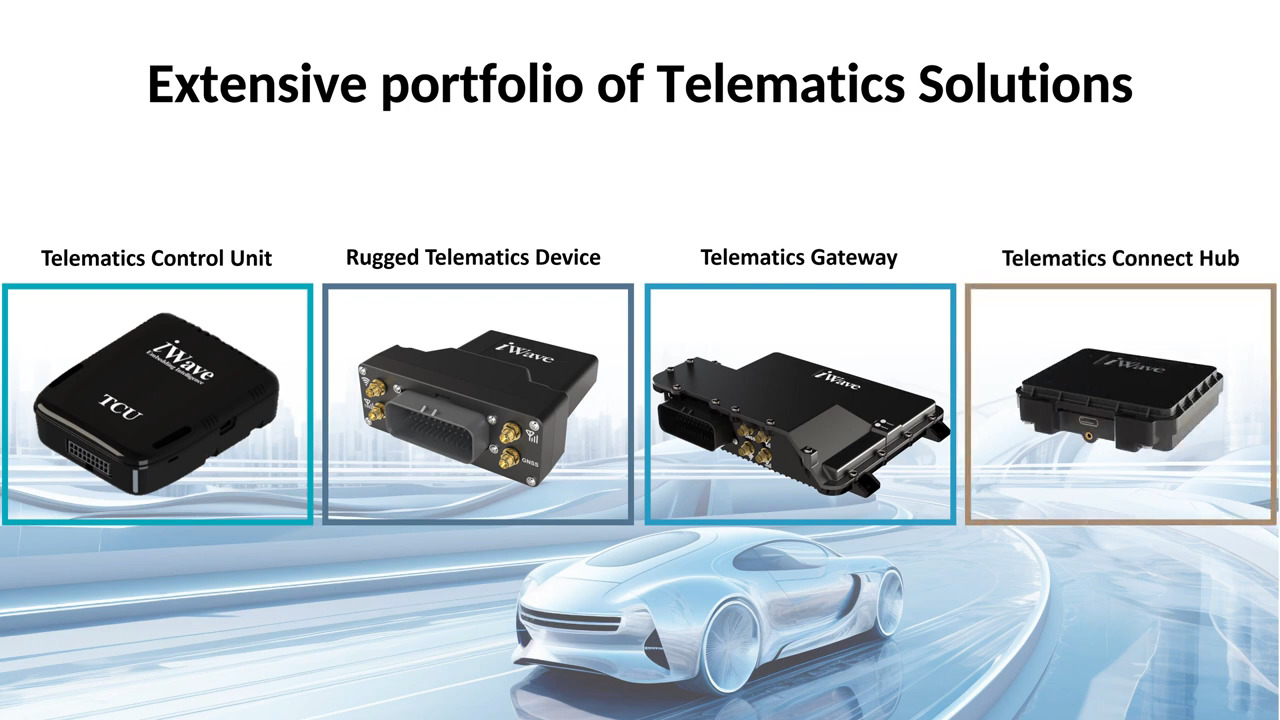
iWave Global has developed a comprehensive portfolio of automotive-grade telematics solutions equipped with advanced wired and wireless connectivity.
Telematics Gateway – iW-RainboW-G41G
- Powered by: NXP i.MX 8XLite MPU
- Connectivity: 5 x CAN FD ports, 2 x Automotive Ethernet ports
- Wireless: LTE Cat 4 and 5G Cellular, Wi-Fi 6, Bluetooth
- Positioning: High-Accuracy GNSS Module
- I/O Support: RS232, RS485, Analog and Digital I/Os
- Security: Integrated Hardware Secure Element
- Enclosure: IP67-rated with external antenna support
Designed for rugged automotive environments, iWave’s telematics gateway (Figure 3) combines Ethernet, 5G, and edge computing capabilities enabling real-time vehicle data aggregation, analytics, and remote updates with uncompromising reliability.
 Figure 3: iWave Global’s Telematics Gateway – iW-RainboW-G41G. (Image source: iWave Global)
By adopting Automotive Ethernet, iWave’s telematics platforms deliver higher bandwidth, standardization, and IP-based networking, supporting features like:
- 360° camera systems
- Predictive maintenance & diagnostics
- V2X (Vehicle-to-Everything) communication
- Secure over-the-air (OTA) updates
Summary
The convergence of performance, efficiency, and scalability positions iWave as a key enabler of future-ready connected vehicles.
iWave Global is a trusted provider of embedded systems and ODM design services with deep expertise in automotive, industrial, and IoT markets. The company specializes in telematics control units (TCUs), gateways, and connectivity platforms that empower OEMs and Tier-1 suppliers to build robust, secure, and high-performance automotive solutions.
With its long-term product availability, design services, and global partnerships, iWave continues to drive innovation in the connected mobility ecosystem.
For more information or to explore custom telematics solutions, visit www.iwave-global.com or contact mktg@iwave-global.com.
About this author

A strong interest in product marketing coupled with a passion for IoT and Wireless Solutions, Tawfeeq specializes in building connected mobility solutions and Industrial IoT Solutions. With data being the new money, there is a dependency for rugged gateways and innovative hardware. Tawfeeq likes to help companies in their transformation journeys.

Have questions or comments? Continue the conversation on TechForum, DigiKey's online community and technical resource.
Visit TechForumMore Blogs from this Author